
Securing a Toronto Luxury Apartment from Abroad: A 2026 Guide for International Executives & Relocators
Securing a luxury apartment in Toronto from abroad involves a different sequence of decisions than a local rental search. The buildings best suited to international executives and corporate relocators are not simply the ones with the best finishes or the most amenities. They are the ones whose management teams understand that an arriving executive may need to sign a lease without a Canadian credit history, coordinate a move-in without being in the country yet, and have a furnished suite ready on day one. This guide walks through the complete pre-arrival and arrival workflow, from virtual tour to move-in, with particular attention to the friction points that catch international renters off guard.
Pre-Arrival Lease Workflow: Virtual Tours, Deposits, and Documentation
The lease process for international renters differs from the standard Canadian rental workflow in several important ways. Understanding the sequence in advance reduces delays and prevents the most common points of friction.
Virtual tours are now standard at reputable luxury rental buildings in Toronto, but the quality varies significantly. A video walkthrough produced for marketing purposes is not the same as a live-streamed tour conducted by a leasing agent who can answer questions in real time, adjust the camera angle to show the specific suite being offered, and walk through the amenity floor. When evaluating a building remotely, request a live virtual tour of the specific suite you would lease, not a model unit or a floor-plan equivalent.
The lease documentation workflow for international renters typically proceeds electronically. Canadian leases are governed by Ontario’s Residential Tenancies Act, a standardized legal framework that protects tenants, including international ones, from the moment the lease is signed. Electronic signatures are legally valid in Ontario. A landlord may collect a rent deposit equal to one month’s rent (used to cover the final month of the tenancy) plus the first month’s rent. Damage, security, cleaning, and pet deposits are prohibited under Section 105 of the Residential Tenancies Act, 2006. Landlords are required to pay annual interest on the last month’s rent deposit at the prevailing rent increase guideline rate. International wire transfers for deposits are handled routinely by reputable Toronto rental buildings.
The lease start date can be set in advance of your arrival, allowing the suite to be ready and the concierge to be briefed before you land.
Pre-Arrival Lease Workflow
| Step | Timeline | What to Do | Common Friction Points |
|---|---|---|---|
| Virtual tour | 6 to 10 weeks before move-in | Request a live tour of the specific suite; ask to see all amenities | Model units may not reflect actual suite condition or finishes |
| Lease application | 4 to 8 weeks before move-in | Submit application with employment documentation and references; confirm deposit wire instructions | Credit check may show no Canadian history; address proactively with employment letter and bank statements |
| Lease signing | 3 to 6 weeks before move-in | Review Ontario Residential Tenancies Act framework; sign electronically | Only a last-month rent deposit is legal in Ontario; damage/security deposits are prohibited |
| Deposit transfer | At or before lease signing | Wire last month’s rent deposit per confirmed instructions | Retain wire confirmation; allow 3 to 5 business days for international transfers |
| Suite prep confirmation | 1 to 2 weeks before move-in | Confirm furnished or unfurnished status; arrange key handoff logistics with concierge | Furnished suites require advance confirmation of inventory and condition |
| Move-in day coordination | Day of arrival | Coordinate elevator booking, moving vehicle arrival, and concierge briefing in advance | Peak summer move-in days require advance booking; do not assume same-day elevator access |
Credit and Reference Requirements for Non-Canadian Renters
The credit check is the single most common source of friction for international renters in Toronto’s rental market. Canadian credit bureaus maintain records only for activity conducted within Canada. An executive arriving from New York, London, or Singapore with a 30-year financial history has no Canadian credit record, and a standard credit check returns no data rather than a positive result.
Reputable luxury rental buildings have established protocols for international renters that substitute equivalent documentation for a credit check. The standard package for corporate and executive relocations includes the following.
An employment letter on corporate letterhead confirming the nature and duration of the role, the compensation structure, and, where relevant, that the employer is funding or reimbursing the rental. This letter carries more weight with experienced leasing teams than a credit score, because it directly addresses the landlord’s actual concern: payment certainty.
Three months of bank statements from the primary international account, showing sufficient reserves to cover rent payments comfortably. The statements do not need to be from a Canadian bank at the application stage.
A reference letter from a prior landlord or property manager, even from abroad, confirming tenancy history and payment record. International references are accepted by reputable buildings.
Where an employer is facilitating the relocation, a direct billing or corporate housing agreement with the building eliminates the personal credit question entirely. Many Toronto luxury rental buildings have established corporate account relationships with major employers and relocation management companies.
Documentation for International Renters
| Document | Purpose | Notes |
|---|---|---|
| Employment letter on corporate letterhead | Demonstrates payment certainty; often sufficient in lieu of credit score | Should confirm role title, duration, compensation structure, and relocation support |
| Three months of international bank statements | Demonstrates financial capacity | Statements from any reputable institution accepted; Canadian bank account not required at application |
| Prior landlord reference (international accepted) | Demonstrates tenancy history | Written references from property managers carry more weight than informal references |
| Corporate housing or direct billing agreement | Eliminates personal credit requirement entirely | Available where employer has a relocation or corporate housing program |
| Passport copy | Standard identification requirement | Required for all applicants regardless of residency |
| Proof of incoming employment start date | Confirms timeline for Canadian income to begin | Useful for applications where employment letter alone may be borderline |
Furnished and Serviced Apartment Options
International executives relocating to Toronto for corporate assignments typically arrive in one of two situations: they need a furnished suite immediately, or they need time to ship furniture and establish a household while living in a functional space. Both situations call for different solutions, and the buildings best suited to executive relocators are designed to accommodate both.
A fully furnished suite includes all furniture, appliances, linens, kitchenware, and household essentials required for immediate occupancy. The quality of furnished suites in Toronto’s luxury rental market varies considerably; the most important question to ask is whether the furnishings match the quality of the building’s standard finishes or represent a lower-grade inventory added for convenience.
A corporate or serviced apartment arrangement typically adds housekeeping, linen service, and utilities within the monthly cost, simplifying expense management for corporate relocation programs. This format suits executives on assignments of six to eighteen months, where the goal is a fully operational home from day one without the administrative overhead of utility accounts and household setup.
A standard unfurnished luxury suite allows the executive to establish a permanent household at their own standard. This suits longer-term relocations of 18 months or more. Buildings with strong move-in infrastructure, including an indoor moving room, elevator booking systems, and concierge coordination, reduce the friction of this process substantially.
Furnished and Tenancy Format Options
| Format | Best For | Lead Time | What to Confirm |
|---|---|---|---|
| Fully furnished suite | Short-term assignments (3 to 12 months); immediate occupancy | 2 to 4 weeks | Furniture quality and inventory list; housekeeping availability; utility inclusion |
| Corporate / serviced apartment | Mid-term assignments (6 to 18 months); expense-managed | 2 to 4 weeks | All-inclusive pricing structure; what is included vs. billed separately |
| Unfurnished with move-in support | Long-term relocations (18+ months); permanent household | Standard lead time | Move-in room and elevator availability; concierge coordination for delivery management |
| Corporate direct billing | Any duration where employer funds rent | Varies by employer | Confirm building’s existing corporate account relationships before applying |
What to Look for in Concierge Support
For international executives, the concierge team is not a convenience feature. It is the operational infrastructure that determines whether the first weeks in a new city are manageable or stressful. The difference between a building with a lobby desk and a building with a genuine 24/7 hotel-style concierge operation is most visible at the specific moments that matter most to a relocator.
Arrival coordination is the first test. An executive arriving late on a Wednesday evening after a transatlantic flight needs to know that the key is waiting, the suite is prepared, and a staff member is available to walk them through the building. Buildings with 24/7 concierge operations handle this as a standard service. Buildings with staffed hours only during business hours require the arriving resident to self-manage.
Package and delivery management matters more than most renters anticipate. In the first weeks of a new Toronto residency, an executive is typically receiving corporate welcome packages, SIM cards, banking correspondence, online purchases, and shipped personal items simultaneously. A building with refrigerated package storage and a food delivery station means the executive does not need to be physically present to receive anything.
Communication before arrival is the most underappreciated service dimension. A concierge team that proactively reaches out to a new resident before move-in, confirms the suite preparation, shares building information, and answers logistical questions in advance converts a potentially stressful arrival into a managed transition.
Concierge Evaluation Criteria
| Criterion | What to Ask | Why It Matters |
|---|---|---|
| 24/7 availability | Is concierge staffed 24/7 or during business hours only? | Late arrivals, international time zones, and weekend emergencies all require after-hours access |
| Pre-arrival briefing | Will the concierge team contact me before I arrive to prepare the suite? | Proactive communication converts a stressful arrival into a managed transition |
| Package and delivery handling | Is there a package storage system? Is refrigerated storage available? | International renters receive high package volumes in first weeks; on-site handling eliminates the need to be present |
| Move-in coordination | Can the concierge book the elevator and coordinate moving crew arrival times? | Building’s peak move-in periods require advance planning; concierge coordination avoids conflicts |
| Guest management | Can the concierge manage guest arrivals on my behalf? | Executives hosting visitors or colleagues need dependable, professional guest handling |
| Local knowledge and referrals | Can the concierge refer me to local services (doctors, banks, transportation)? | New-to-city executives rely on on-site knowledge to build local networks quickly |
Neighbourhood Selection for International Newcomers
Toronto’s geography rewards neighbourhoods that combine transit access, walkable daily essentials, and residential character. For international executives whose first priority is reducing friction, the Yonge-Eglinton corridor and the Bloor-Yorkville area are the two primary options in the luxury rental segment.
Yonge-Eglinton provides direct access to the Yonge-University subway line and the Eglinton Crosstown LRT, connecting residents to downtown employment corridors in approximately 20 minutes and to Pearson Airport via the UP Express at Union Station in approximately 50 minutes. The corridor is walkable for daily essentials: grocery stores, pharmacies, cafes, and restaurants are all within a 10-minute walk of most buildings. The residential pockets just off the core corridor, including Mount Pleasant West and Davisville Village, provide a quieter living environment while retaining the full transit and retail access of the area.
Bloor-Yorkville is Toronto’s most internationally recognized luxury address, with proximity to the consulate cluster, luxury retail, and the Bloor-Yonge transit interchange. Buildings in Yorkville tend to be priced at the upper end of the luxury rental market and attract a resident mix that includes many international renters and executives. The trade-off relative to Yonge-Eglinton is that most buildings in this area are newer construction and therefore outside Ontario’s rent-control framework.
Neighbourhood Comparison for International Executives
| Factor | Yonge-Eglinton | Bloor-Yorkville | Notes |
|---|---|---|---|
| Transit access | Yonge-University subway and Eglinton Crosstown LRT interchange | Bloor-Yonge subway interchange | Both corridors provide excellent connectivity to downtown and Pearson Airport |
| Walkability | High; daily essentials within 10-minute walk | Very high; dense retail and dining district | Both score above 90 on Walk Score |
| Consulate proximity | 20 to 30 minutes by subway | Walking distance to consulate cluster | Executives with frequent consular requirements may prefer Yorkville |
| Building scale options | Mix of boutique and large-format | Primarily high-rise towers | Boutique luxury buildings more available in Yonge-Eglinton corridor |
| Rent control availability | Available in pre-2018 buildings | Limited; most Yorkville buildings are newer construction | Executives on multi-year assignments benefit from rent-controlled leases |
| Residential character | Quieter pockets available one block from core | Active retail corridor; urban density | Personal preference and lifestyle determine the better fit |
| Price range | Slightly lower for equivalent product | Premium pricing for Yorkville address | Comparable suite types can cost 15 to 20% more in Yorkville |
Settling-In Logistics: Utilities, Banking, Phone, and Move-In Coordination
The administrative setup of a new Toronto residency involves a sequence of tasks that interact with each other in ways that are not obvious to international renters. Understanding the dependencies in advance reduces the total setup time from several weeks to several days.
Phone and SIM. A Canadian phone number is the practical prerequisite for almost everything else in the setup sequence: banking applications require a Canadian number for verification codes, many online services require a local number, and your building’s concierge team needs a number to reach you. A Canadian SIM card can be purchased on arrival without a SIN (Social Insurance Number). Rogers, Bell, Telus, and their flanker brands all sell prepaid SIMs at Toronto Pearson Airport and throughout the city. A prepaid plan can be converted to a postpaid plan once you have a Canadian banking relationship.
Banking. Opening a Canadian bank account without a Canadian credit history is straightforward at the major banks. TD Bank, RBC, Scotiabank, and BMO all have newcomer banking programs specifically designed for international arrivals. The required documents are a passport, a Canadian address (your building’s address suffices), and your employment letter. A SIN is recommended but not always required at account opening. The account is typically operational within one to two business days.
Social Insurance Number (SIN). A SIN is required for employment income in Canada and for tax filing. It is issued by Service Canada. International executives on a work permit can apply online or in person at a Service Canada location; processing is typically same-day for in-person applications. You do not need a SIN to open a bank account, get a phone number, or sign a lease.
Hydro (electricity). In Toronto, most customers are served by Toronto Hydro. Purpose-built rental buildings typically have sub-metered suites, meaning each suite has its own hydro account. The leasing team or concierge will provide the account setup instructions; the process requires your name, suite address, and a form of identification.
Settling-In Sequence and Timeline
| Task | When | What’s Required | Notes |
|---|---|---|---|
| Purchase Canadian SIM | Day 1 or at airport | Passport; no SIN required | Prepaid SIM available at Pearson Airport; convert to postpaid after banking is established |
| Open Canadian bank account | Day 1 to 3 | Passport, Canadian address, employment letter | Major banks have newcomer programs; account typically active within 1 to 2 business days |
| Apply for SIN | Week 1 | Work permit, passport | In-person at Service Canada; typically same-day processing for in-person applications |
| Set up hydro account | Before or at move-in | Suite address, name, identification | Building concierge or leasing team provides utility setup instructions |
| Schedule internet installation | Before move-in | Suite address, confirmed move-in date | Rogers, Bell, or preferred provider; installation requires in-suite appointment |
| Register with employer HR | SIN (for payroll), Canadian bank account | Coordinate with relocation manager or HR contact | |
| Register vehicle (if applicable) | Within 60 days of arrival | Ontario address, out-of-province registration, insurance | ServiceOntario handles vehicle registration; out-of-province licences valid for 60 days |
The Whitney on Redpath: Built for the International Executive
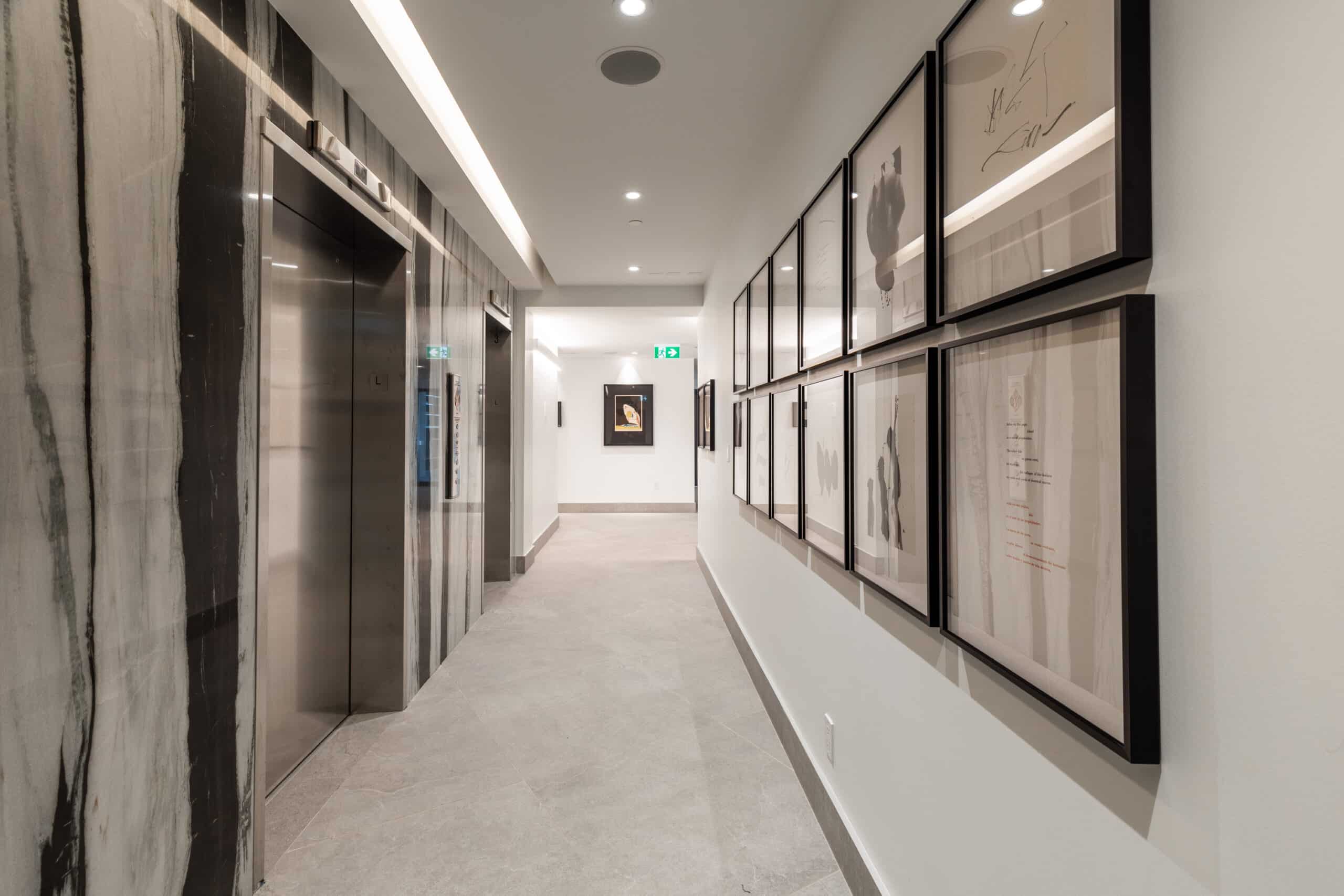
The Whitney on Redpath at 71 Redpath Avenue addresses every dimension of the international executive relocation workflow, beginning before arrival and continuing through the full settling-in sequence.
The 24/7 hotel-style concierge service at The Whitney on Redpath operates with the depth and scope that international executives require: pre-arrival suite preparation, key coordination for late or off-hours arrivals, refrigerated package storage and a food delivery station for the high-volume delivery period that characterizes the first weeks of a new residency, guest suite availability for colleagues or family arriving while the executive settles in, and an indoor moving room with direct elevator access that eliminates the coordination friction of high-rise move-ins.
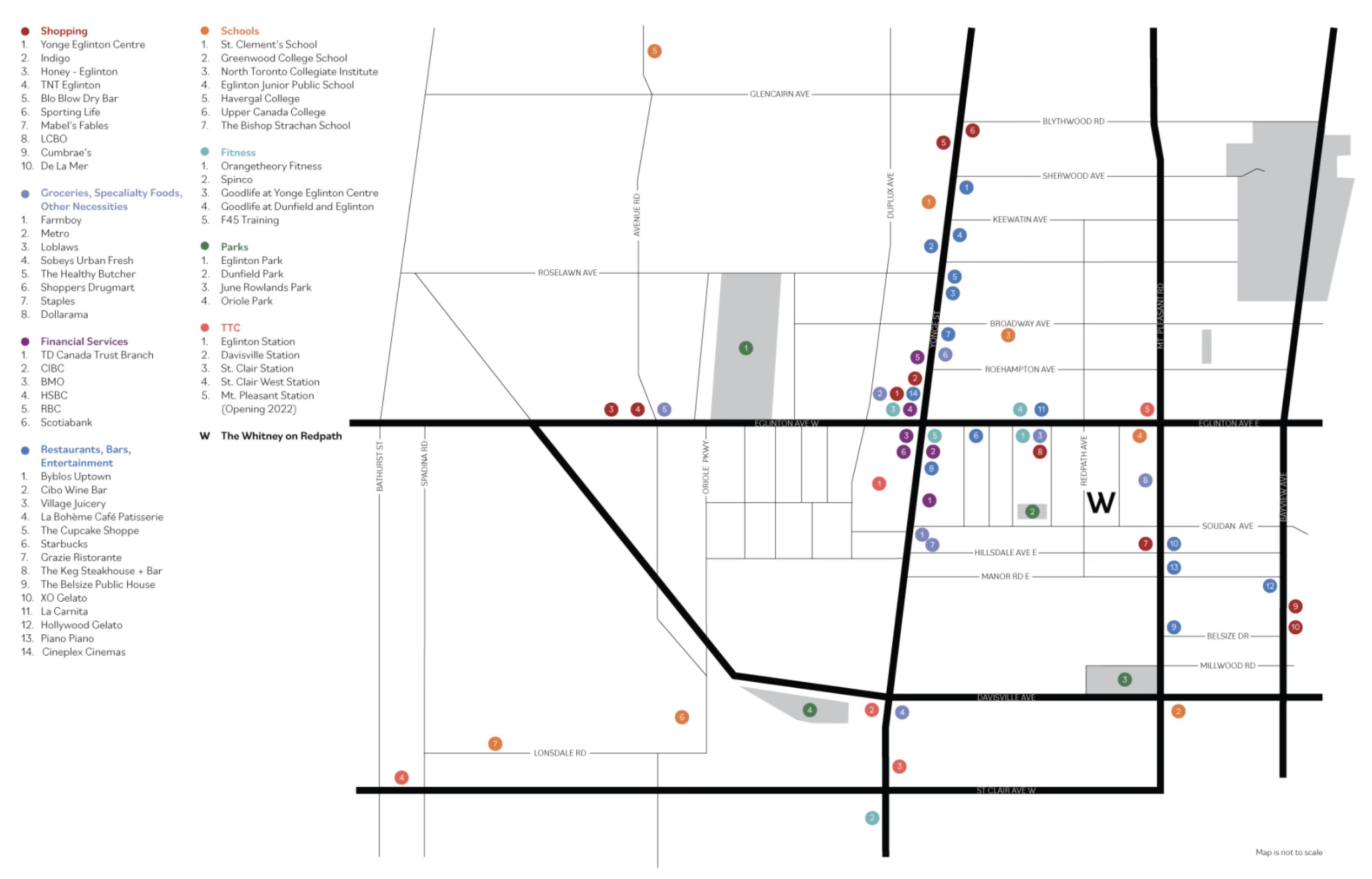
The Whitney on Redpath is the most exclusive boutique luxury apartment building in Midtown Toronto, with only 180 suites, a scale that allows the concierge team to brief itself on new arrivals before they land rather than after. Three elevators for 180 suites means elevator availability that peak-season high-rise move-ins cannot reliably promise. The building sits at 71 Redpath Avenue on a quiet tree-lined residential street steps from Yonge and Eglinton, placing executives within a 5-minute walk of Eglinton subway station on the Yonge-University line, with direct access to downtown employment corridors and the UP Express connection to Pearson Airport at Union Station.
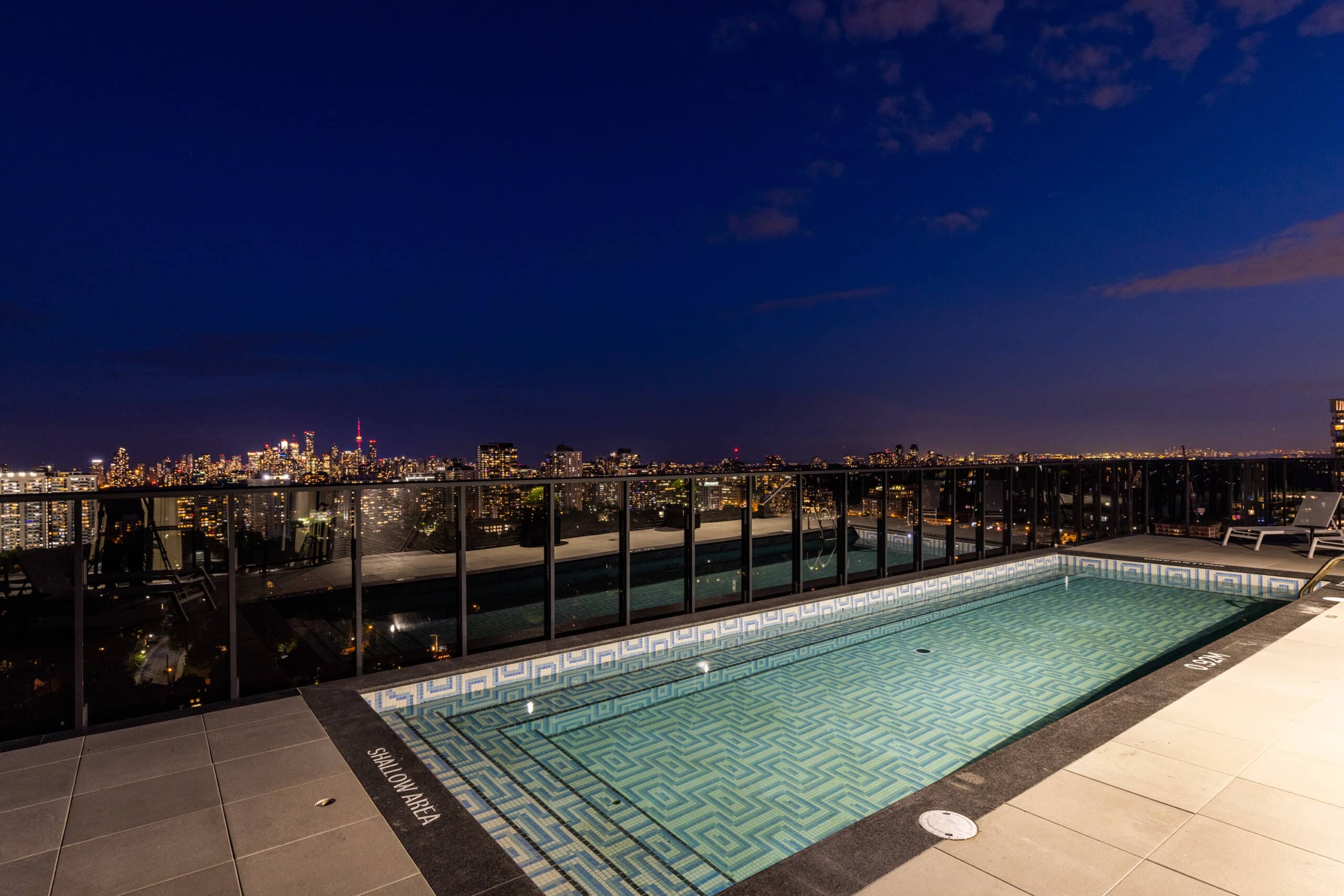
The Whitney on Redpath is the only boutique apartment building in Midtown Toronto with a rooftop pool, BBQ area, and year-round indoor cabana lounge, and features a 3,500 sq. ft. fitness studio with spin studio, yoga studio, cardio theatre, and TRX system, amenities that allow an executive to maintain their health and wellness routine from day one without sourcing a gym membership in an unfamiliar city. The building is managed by The Benvenuto Group, a developer-operator with over 1,000 rental suites in development across Toronto and Montreal, with 35 years of experience building and managing luxury residential projects for discerning renters. To learn more or arrange a virtual tour, visit thewhitneyonredpath.com.